
How to Judge a Book
A controversial take on Theo of Golden

A couple of weeks ago, I announced that I’ll be joining the MFA in Creative Writing at Whitworth University as the first-year spiritual writing mentor. If you missed that news, you can catch up here.
I’m often asked about my own experience in an MFA program, and one of the things I most appreciated during my time was the expansive reading we did (60 books in total). This wasn’t a requirement to read a few books closely. It was the invitation to absorb a lot of different kinds of books, especially with one primary question in mind: what is making this work (or not work)? The reading responses I wrote were nothing like the papers I wrote for an earlier graduate program in literature, though they did provide a lot of practice in articulating reasons to commend (and also criticize) a book. This is an education I’ve needed because it hasn’t always been my habit to read critically.
The habit of judging books could, of course, become a snobbish one. It’s tempting to make reading just one more elitist activity, something to put on with pride, something to separate people into classes of better and worse. I hope you’ll see this isn’t my intent with this post—because I realize that people read novels for all kinds of reasons. Sometimes we just want a good plot and likeable characters. We want to be moved emotionally. We want, if only for a few quiet moments, to inhabit a life that isn’t ours. I don’t fault the escapist motivation for reading, though it may not always serve us well for judging whether a book is really working beyond the level of entertaining us.
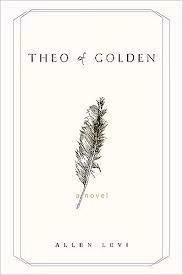
The novel I want to talk about here—Theo of Golden—is one that comes highly recommended by people I love and trust. This makes me second-guess my own reaction to the novel, to think that there must be something wrong with me if they—and 11,000 other people—are hailing it. It doesn’t help that the book is billed as the act of “spreading kindness”—because who can complain about that? Still, I stand by this assessment, that though this book may make you feel good about the world, this may be exactly the reason you reject it as being either good or Christian.
In this case, the novel is wrought with artful language—and, as I found it, exaggerated artistry. It’s not a book of constraint, but excess. It’s also a story where good always and necessarily triumphs over evil in the most predictable ways. Despite the tragic turn at the end of the book, even this escapes the feeling of the hideous or fatefully cruel.
Basically, it’s a book that looks nothing like real life. There are few complications, infrequent contradictions, nothing to suggest that humans are profoundly unreliable creatures, living with good intentions and glaring self-deceptions. Perhaps characterization of the world makes me a cynic, convincing anyone that I don’t believe in true kindness. Yet I think it makes me a realist exactly as the biblical authors were.
Here is Robert Alter, a Hebrew scholar, in The Art of Biblical Narrative: “What is it like, the biblical writers seek to know through their art, to be a human being with a divided consciousness—intermittently loving your brother but hating him even more; resentful or perhaps contemptuous of your father but also capable of the deepest filial regard; stumbling between disastrous ignorance and imperfect knowledge; fiercely asserting your own independence but caught in a tissue of events divinely contrived; outwardly a definite character and inwardly an unstable vortex of greed, ambition, jealousy, lust, piety, courage, compassion, and much more?” The point is that the biblical writers rendered a believable world, with believable people, none of whom were angels.
If a novel gives me a protagonist who acts like an angel, I can’t help but find myself a little suspicious.
It just so happens that I finished Theo of Golden and then began reading Wallace Stegner’s Crossing to Safety. As far as I know, the 20th-century novelist was not a person of faith, so it’s not as if he was writing “Christian” fiction, whatever we might mean by that. But the novel is a lovely and completely human story of two couples and their friendship.
There is no magisterial plot, which is really the point, I suppose. It’s a rendering of life as you and I would recognize it. Difficulties, disappointments, love, envy, accident. “Drama demands the reversal of expectations,” one character says in the novel, which is exactly why I have to conclude that Theo of Golden ultimately disappointed me. There was no drama, no ambiguity, no surprise, only unthreatened good.
Why am I bothering with all this? Because it’s a Monday, and I’m feeling cranky? Maybe. But I suppose it’s also to say: tell me where I’m wrong! If you read Theo of Golden and loved it, give me all the reasons I’m the worst of book critics and the biggest of book snobs.
But maybe I’m also writing to foster a conversation about the kinds of novels that endure. I think the best stories can make us hope for a better world—but if they want to be credible in their hope, they need to allow us to grapple honestly with the world as we have it.
Yes, let us have joy—but let us remember that in this life, joys are more often hard-won. We are hard-pressed on every side, the Apostle Paul says. Afflicted, not crushed. Perplexed, not driven to despair. Struck down, not destroyed.
My takeaway from this post (as someone who has not read Theo!)... I want to hear your thoughts on Crossing to Safety when you're done!
I didn't think Theo was a perfect book but I enjoyed it. Interestingly, some books that I wouldn't consider masterpieces stick with me for a long time, and Theo was one of those - specifically, the pencil portraits in the book. Ever since I finished Theo, I'll sometimes see a person's face and imagine what a drawn portrait of it would look like, what part of that person's life and character would be captured in the drawing. It's almost like picturing an icon of them. So, I suppose there's some sacramentality in Theo that captured my imagination? It's given me plenty to contemplate in the last year and a half!