
Praying the Psalms
And learning to pray

This month, I’m writing about habits of the spiritual life. Today’s habit is prayer.
I certainly couldn’t choose a favorite among the incredible gifts I received from my children this past Christmas. A delicious new perfume, from one daughter. Two handmade artisan pinch pots from my other daughter. A printed and bound copy of one son’s original novella, which I’d been begging to read. A leather-bound Psalter, from my other two sons. As I might deny the existence of a single favorite child, so too I deny the existence of a single favorite Christmas gift. Each gift was as uniquely marvelous as the giver!
For the purpose of this essay, however, I want to tell you about the Psalter that two of my sons gave me. (Psalter is just a fancy way of saying The Book of Psalms, by the way.) If you could covet a psalter, maybe I had been coveting this one, which my son’s girlfriend owns. It’s published by the Anglican Church in North America, at least one more obvious sign that I may be, as my friend, Tish, has said, a “closet Anglican.”
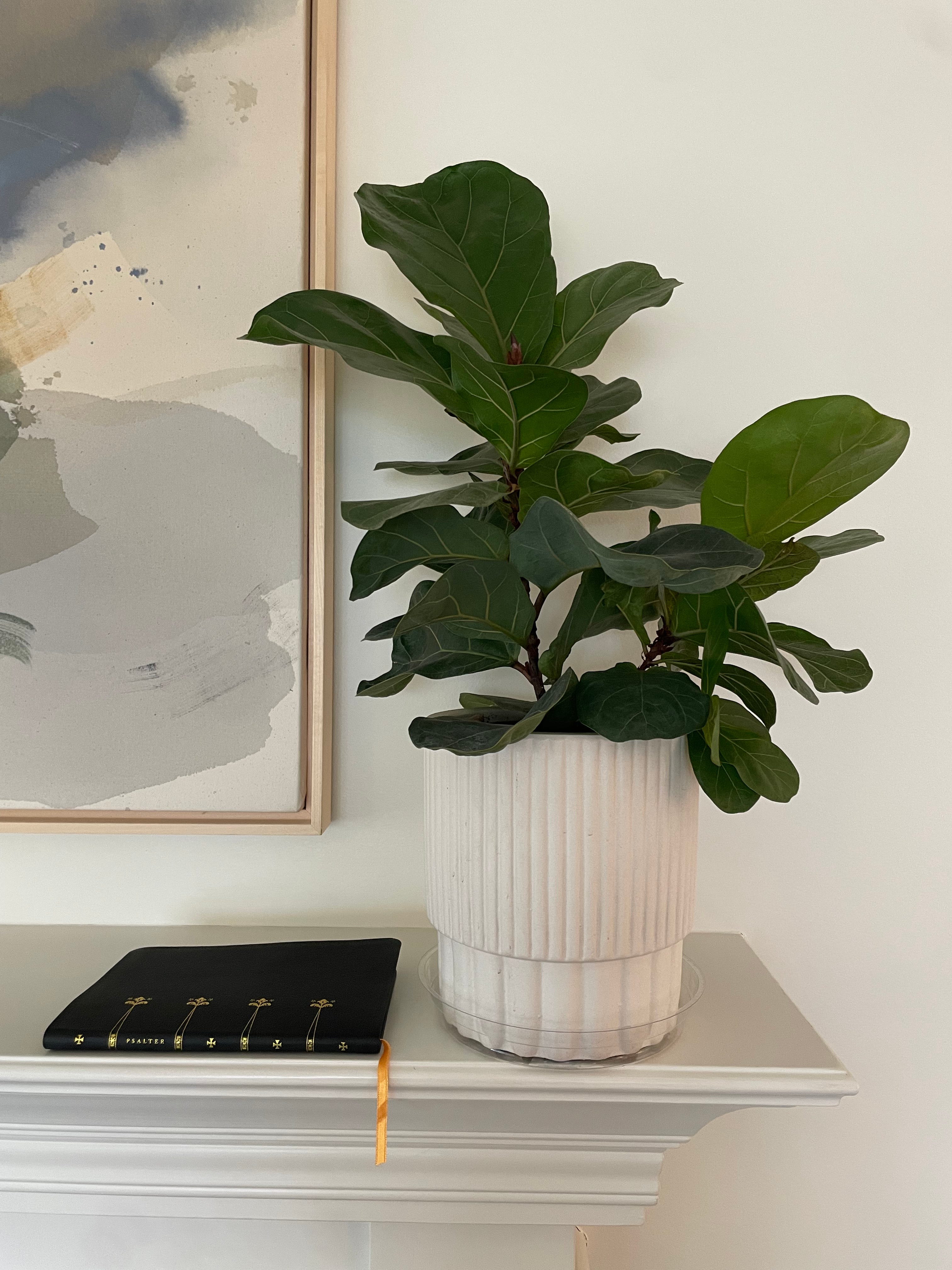
This Psalter intends that you should read all 150 psalms in a month, presuming that you read both the morning and the evening office. Each psalm is marked with indications of how you might properly chant the psalm, though I confess that I have not yet progressed to chanting my psalms, even if the argument for doing so is pretty strong. On that subject, the editors write:
Hurry and haste [in chanting] must be vigorously opposed. Not that chanting must be heavy and ponderous. On the contrary, there should be a lightness and readiness to the chant. Rather there should simply be no hurry: No glancing ahead, no trying to speed up. One’s mind should be attentive singularly to the verse that is on the lips. If one is out of breath, or if one cannot remember the content of the previous several verses, these are sure signs of chanting too fast. It is often helpful to pray an instantaneous arrow-prayer throughout the psalms, between verses, “Lord, help me to pray!” (vi).
The Psalms have been the bedrock of Benedictine spirituality, which has been of interest to me in my learning about a rule of life, and it’s one reason I’m endeavoring (Lord, help me!) to memorize all 150 with the time I have left on this precious earth.
In his Rule, Benedict called for his communities to follow a schedule of chanting/singing all 150 Psalms every single week. “For monks who in a week’s time say less than the full psalter with the customary canticles betray extreme indolence and lack of devotion in their service,” (chapter 19). Though this may sound severe to us, Benedict understood that if accusations were drawn up against him on account of this schedule, it would not be for too much strictness, but too much laxity. “We read, after all, that our holy Fathers, energetic as they were, did all this in a single day. Let us hope that we, lukewarm as we are, can achieve it in a whole week.”
The point of singing the Psalms every week wasn’t legalism. The point was formation. Benedict seemed to be saying: here’s a book, given to God’s people, to teach us to pray. Take it up. Rehearse the lines. Get fluent in this language.
I wonder if we think of prayer in this way.
On the one hand, I think it’s important to say to God’s people, especially those new to discipleship to Jesus, that prayer need not be complicated. Jesus gave us a simple prayer after which we should model our own praying. Our Father in heaven, hallowed by your name. The Lord’s Prayer teaches us to reverence God, to desire his rule, and to submit every need to him. If you never broke open the book of Psalms, this prayer would be fully adequate for learning to pray. Start here—and you will go very far in learning to speak to God and listen to his Spirit speak back.
Yet we do have the Psalms. And they do give us a depth of language with which to understand reality and seek audience with the Maker of heaven and earth. So, there’s good argument for pressing into more learning on prayer. And I suppose that if you had an important meeting with a higher-up in your company or an audience with a political official or even an important conversation with a future in-law (ha! had to sneak that one in), you’d do a little preparing. You’d want to understand the protocols, prepare your talking points, make sure to show proper deference and respect.
Now imagine talking to the Holy One.
There’s a drive in contemporary spirituality toward authenticity. Be your truest self with God. I think this is not terrible advice. The Psalms tell us that God delights in truth in the inward being and teaches wisdom in the secret heart. To be false in prayer is not to pray. But I would add: take up the Psalms, and rehearse the lines. Get fluent in this language. Apprentice yourself to skills other than speaking your honest words to God; learn to have God’s word in you, which you then speak back to him.
I’ve thought about learning to speak God’s words back to God in our current political moment. I’ve made no secret that I abhor many policies of this current administration—but partisan praying is not kingdom praying. I’m convinced of this. And while I may not have voted for this president, it is now my Christian duty to pray for him and for his administration. Yet the question remains: how do I do this as God has commanded?
How do I not let my own half-truth perspectives dominate the landscape of my prayer?
I take up the Psalms. I rehearse the lines. I get fluent in this language. When, for example, another student from our ESL class is scheduled for an immigration check-in, I don’t have to look far for words. The morning office includes Psalm 72, this prayer for God to “give the King Your judgments, and your righteousness to the King’s son.”
Though I am tempted to give into the despairing, embittered spirit of the age, all of a sudden, the Spirit is praying in me what I might not have had faith or hope to pray: that this righteous king (or immigration official) “shall deliver the poor when he cries, the needy also, and the one that has no helper. He shall be favorable to the lowly and needy and shall preserve the lives of the poor. He shall deliver them from falsehood and wrong,” (vv. 12-14). I see God’s heart for friends like mine, and I am swept up into the cosmic compassion that governs the world. I do not know that we will have what we’ve asked, the many of us who are praying for our friend’s safety, but I do know that I must center here, in the posture of this prayer.
Lord, teach us to pray, the disciples asked Jesus. They knew that like small babies, born into a world without the capacity of formal human speech, they had to learn to talk to God. It would take practice to learn to seek his kingdom and do his will, to forgive and be forgiven, to want more and less at the very same time.
You may not read the Psalms in a year, much less a month or a week. But where can you begin today, to make this book a daily prayer companion?
Brad East, whom I recently interviewed about his book, Letters to a Future Saint, recently published an important piece on Christianity Today entitled, “So What if the Bible Doesn’t Mention Embryo Screening?” Talking about the need for clear biblical and moral reasoning on new technological questions, East puts his finger on something relevant to my post here, about needing God’s word in us if we are to pray (and live) well.
“Discernment,” he writes, becomes in many contexts a word vaguely meaning, “Do as you please.”
“It ends up making grave ethical matters into subjects for private judgments, born of little more than instinct, however sincere or prayerful.” Read more here.
Next month’s posts will be about friendship! What particular themes or questions might I try to address?
Thank you for your post on praying the Psalms today. It’s a much needed reminder and encouragement.
I live in Minnesota and so much of what we are seeing/experiencing in these recent weeks is heartbreaking. It’s hard not to just give way to anger. The Psalms give us the words to express our grief and frustration / anger and to ask God to intervene with divine wisdom and justice in these difficult times.
“God is our refuge and strength,
an ever present help in trouble.” Ps 46
Thank you. I read this in full this morning. Prayer has always felt like a have to, not a get to. I love the simplicity of taking written words spoken through the ages and simply allowing them to be sufficient. This feels freeing.